Thermal analysis techniques such as Thermogravimetric Analysis (TGA), Differential Scanning Calorimetry (DSC), and Thermomechanical Analysis (TMA) are widely used in the polymer field to evaluate properties such as degree of cure and crosslink density. Their relevance, however, extends far beyond these applications. Thermal analysis has become an essential tool in both R&D and quality control of coatings and corrosion‑resistant materials.
What really happens during heating?
In a typical thermal analysis experiment, a sample of only a few milligrams is placed in a crucible and subjected to a controlled temperature program under a defined atmosphere. TGA monitors changes in mass as a function of temperature and time, providing insight into degradation, oxidation, and evaporation processes. DSC, by contrast, measures heat flow associated with thermal transitions such as melting, crystallization, and glass transitions.
Two techniques, one powerful analysis: STA
Modern instruments often combine these techniques in Simultaneous Thermal Analysis (STA), where mass changes and heat flow are recorded simultaneously under identical conditions. This integration significantly improves data accuracy and interpretation.
Experimental parameters, including temperature (from −40 to 1500 °C), heating rate, gas atmosphere (e.g. nitrogen, air, argon), and humidity, can be precisely controlled. In addition, these systems can be equipped with an integrated camera that allows real‑time observation of the sample, directly linked to the temperature profile.
STA in coatings and corrosion analysis
These capabilities make STA particularly well suited for corrosion and coating studies. By adjusting oxygen concentration and humidity, materials can be evaluated under simulated operating conditions. TGA detects mass gain due to oxidation or mass loss due to degradation, while DSC provides complementary information on reaction energetics. Together, these signals enable the determination of oxidation onset temperatures, oxidation induction times, and degradation mechanisms of protective coatings, key parameters for predicting material behaviour under thermal stress. Such insights are also critical for applications exposed to extreme temperatures, such as in the aerospace and automotive industries.
Moreover, DSC allows the identification of glass transition temperatures and curing behaviour, both of which are crucial for coating performance and durability. This information supports formulation optimization and ensures reliable quality control.
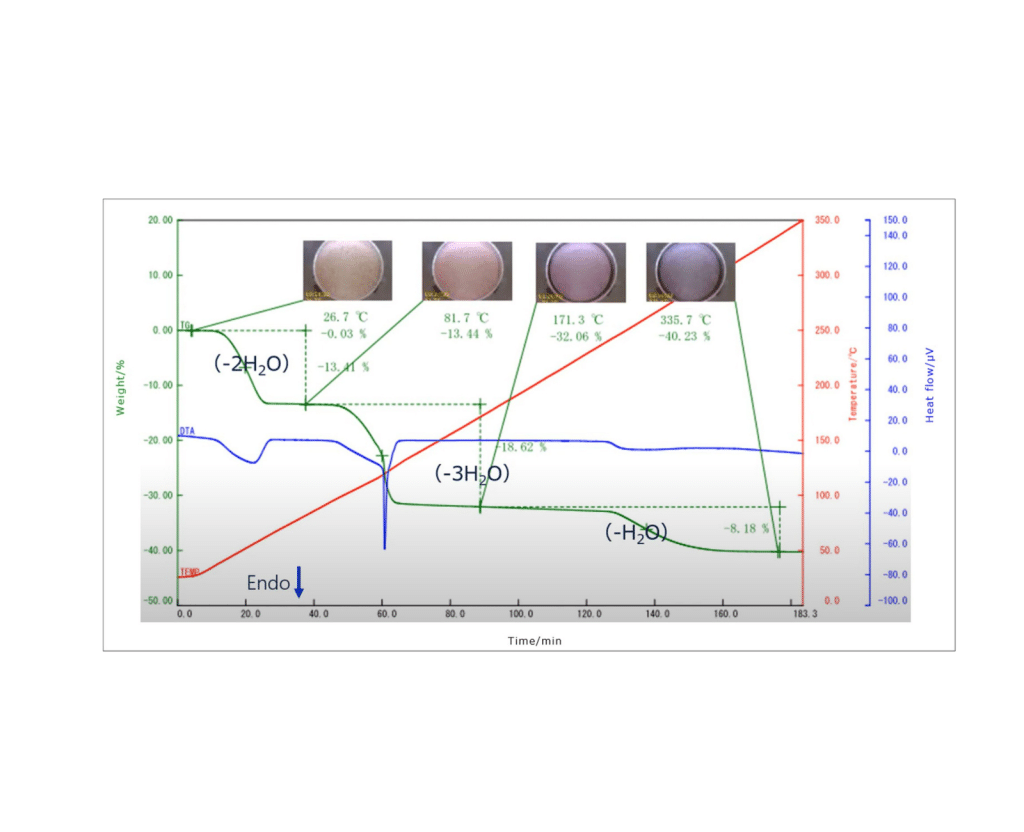
An illustrative example is the analysis of cobalt(II) sulphate heptahydrate, a compound relevant to electroplating processes for applying corrosion‑resistant cobalt alloy coatings. STA measurements performed with the Rigaku STAvesta clearly demonstrate stepwise dehydration through distinct mass‑loss steps in the TGA signal, accompanied by endothermic peaks in the DSC curve. The instrument’s real‑time observation capability additionally provides valuable insight into morphological changes during heating, such as shrinkage and colour changes.

Integration with complementary techniques
High‑throughput features, such as automatic sample changers, significantly enhance laboratory efficiency. Furthermore, thermal analysis can be coupled with evolved gas analysis techniques such as FTIR or GC‑MS, enabling detailed identification of decomposition products. When combined with complementary techniques like TMA, XRF, SEM, and XRD, thermal analysis forms a key pillar of modern materials characterization in coating research.
FAQ
What is thermal analysis and why is it important for coatings and corrosion‑resistant materials?
Thermal analysis encompasses techniques such as Thermogravimetric Analysis (TGA), Differential Scanning Calorimetry (DSC), and Thermomechanical Analysis (TMA) that measure how materials respond to controlled temperature changes. In coatings and corrosion‑resistant materials, thermal analysis is essential for understanding degradation, oxidation behavior, curing, and thermal stability, making it a critical tool in both R&D and quality control.
How does Thermogravimetric Analysis (TGA) work?
TGA measures changes in a sample’s mass as a function of temperature and time under a controlled atmosphere. This technique provides direct insight into processes such as thermal degradation, oxidation, evaporation, and dehydration, all of which are key to assessing the durability and performance of coatings.
What information does Differential Scanning Calorimetry (DSC) provide?
DSC measures heat flow associated with thermal transitions in a material. It is used to identify melting points, crystallization behavior, glass transition temperatures, and curing reactions. In coating systems, DSC helps evaluate curing efficiency, thermal transitions, and long‑term performance under heat exposure.
What is Simultaneous Thermal Analysis (STA)?
Simultaneous Thermal Analysis (STA) is an integrated technique that combines TGA and DSC in a single experiment. By measuring mass changes and heat flow at the same time under identical conditions, STA improves data accuracy and enables more reliable interpretation of thermal events.
Why is STA especially useful for corrosion and coating studies?
STA allows coatings and corrosion‑resistant materials to be tested under simulated service conditions by precisely controlling temperature, gas atmosphere, oxygen concentration, and humidity. This makes it possible to determine oxidation onset temperatures, oxidation induction times, degradation mechanisms, and coating stability under thermal stress.