
Menu
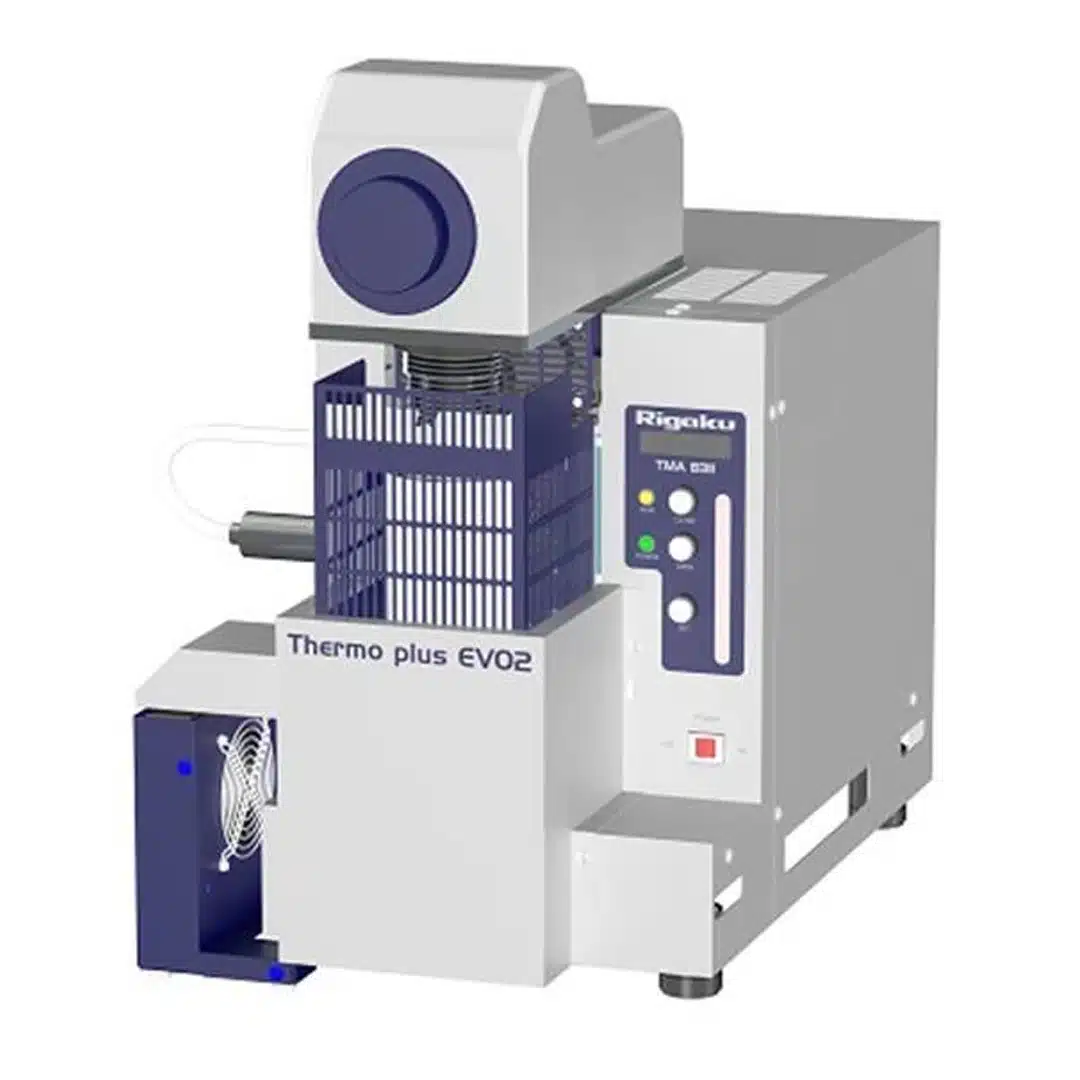
A Thermomechanical analyzer (TMA) measures changes in the shape or dimensions of a material as a function of temperature while a mechanical load is applied. During the measurement, a non-oscillatory force such as compression, tension, or bending is applied to the sample while it is heated or cooled. The system records the resulting displacement to evaluate how the material responds to temperature changes.
The Rigaku TMA8311 uses a differential expansion measurement principle. This design compensates for thermal expansion or shrinkage originating from the detection mechanism itself, improving measurement precision and reproducibility.
In addition to constant load measurements, the system supports different load control options:
Constant-rate loading mode
Sine-wave cyclic loading mode
The optional Sample Controlled TMA (SCTMA) configuration controls the temperature based on the sample’s shrinkage rate. You can use this option to simulate sintering processes in ceramics and to support the production of sintered materials with reduced grain growth.
In thermomechanical analysis, the instrument applies a defined load to the sample and measures dimensional changes during heating or cooling. The appropriate measurement configuration depends on the shape of the sample and the objective of the analysis.
Typical TMA measurement methods include:
Compression loading
Tensile loading
Penetration testing
Three-point bending
From the displacement data obtained in compression or tensile modes, it is possible to calculate thermal expansion and the coefficient of thermal expansion.
The analyzer supports several measurement configurations depending on the sample and the applied load.
Compression loading method
Used to measure dimensional changes under compressive load.
Tensile loading method
Used when a tensile force is applied to the sample.
Penetration method
Measures displacement caused by probe penetration into the sample.
High-sensitivity differential penetration method
Designed for more sensitive penetration measurements.
Three-point bending
Used for bending measurements based on the geometry of the sample.

